
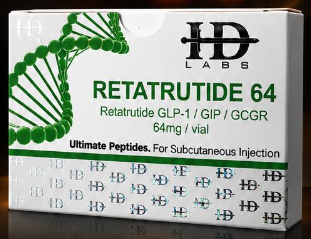

Description
Retatrutide 64mg is a research-grade triple-agonist peptide that targets three metabolic hormone receptors — Glucagon-Like Peptide-1 (GLP-1), Glucose-Dependent Insulinotropic Polypeptide (GIP), and glucagon. Eli Lilly developed the compound as an investigational treatment for weight loss, and in trials it is dosed once weekly via subcutaneous injection after reconstitution with bacteriostatic water.
By the end of this article, you will:
- Understand how retatrutide’s triple-agonist mechanism drives weight loss.
- Know the standard dose escalation schedule and reconstitution steps.
- See how retatrutide compares to semaglutide and tirzepatide, including risks and regulatory status in South Africa.
Key Takeaways
- Mechanism: Retatrutide (LY3437943) is a 39-amino-acid triple hormone receptor agonist developed by Eli Lilly
- Efficacy: Participants assigned to the 12 mg dose lost a mean 24.2% of body weight over 48 weeks in a Phase 2 trial.
- Dosing: Once weekly; an approximately 6-day half-life supports weekly administration.
- Reconstitution: Mix with bacteriostatic water; refrigerate at 2–8°C after mixing.
- South Africa status: Not registered with the South African Health Products Regulatory Authority (SAHPRA); sold for research use only.
- Risks: Gastrointestinal side effects, raised heart rate, and class-wide pancreatitis concerns require medical oversight.
What Is Retatrutide? The Triple Agonist Explained
Retatrutide (LY3437943, CAS 2381089-83-2) is a synthetic peptide developed by Eli Lilly. Retatrutide activates three metabolic hormone receptors at the same time — GLP-1, GIP, and glucagon — making it the first triple agonist peptide to reach late-stage obesity trials
As an incretin mimetic (a synthetic compound that copies natural gut hormones controlling insulin and appetite), retatrutide ships as a lyophilised peptide — a freeze-dried powder. You must reconstitute the powder with bacteriostatic water before subcutaneous injection.
Glucagon receptor activation is the key differentiator. Semaglutide and tirzepatide reduce calorie intake. Retatrutide reduces intake and is proposed to increase output by stimulating fat oxidation in the liver, which raises energy use at rest. This dual-pronged action (less in, more out) is the mechanism behind the 24.2% mean weight loss seen at 48 weeks in the 12 mg arm of the Phase 2 trial.
Some buyers worry that a stronger mechanism means harsher side effects. In the Phase 2 trial, gastrointestinal side effects were dose-related and broadly consistent with the wider GLP-1 drug class when users followed a slow titration schedule (covered below).
How Retatrutide Works: GLP-1, GIP & Glucagon
Retatrutide produces weight loss by activating three metabolic receptors at once. Together, these receptors control how much you eat, how efficiently you process glucose, and how much energy you burn at rest.
- GLP-1 receptor (appetite & satiety) — Slows gastric emptying and signals fullness to the hypothalamus, reducing hunger and meal size. Semaglutide uses this same pathway.
- GIP receptor (insulin sensitivity & fat handling) — Enhances glucose-dependent insulin secretion and influences how adipose tissue stores and releases fat. GIP activity is thought to reduce the metabolic resistance that frequently stalls weight loss on GLP-1-only drugs.
- Glucagon receptor (energy expenditure & lipolysis) — Stimulates hepatic fat oxidation and raises basal metabolic rate, so the body burns more calories at rest. Semaglutide and tirzepatide lack this mechanism.
Why the triple combination matters
GLP-1 and GIP reduce energy intake. Glucagon increases energy output. Combining all three is proposed to create a synergistic deficit — less in, more out — that single- and dual-agonists cannot replicate.
The clinical signal from the Phase 2 trial is strong. Participants assigned to the 12 mg dose lost a mean 24.2% of body weight over 48 weeks, compared with 2.1% on placebo. For context, semaglutide reached about 15% in its Phase 3 obesity trial and tirzepatide about 22.5% in its own trial; these are cross-trial comparisons rather than head-to-head data, but they position retatrutide among the most effective weight-loss compounds study did to date.
Some readers will reasonably ask whether stronger weight loss means higher rebound risk. Phase 3 trials are still in progress, so long-term maintenance data is limited and warrants caution.
Retatrutide Dosage Guide for Weight Loss
In the Phase 2 trial, retatrutide was dosed once weekly via subcutaneous injection. A gradual titration schedule minimises gastrointestinal side effects and builds tolerance to the triple-agonist activity. Below is a representative dose escalation protocol reflecting the higher-dose arm of that trial.
- Weeks 1–4: 2 mg/week — Starting dose to assess tolerance. Nausea and mild gastrointestinal symptoms are most common during this phase; the trial found a 2 mg start was better tolerated than a 4 mg start.
- Weeks 5–8: 4 mg/week — First escalation. Participants whose target dose was 4 mg lost a mean 17.1% of body weight at 48 weeks.
- Weeks 9–12: 8 mg/week — Advance only if the 4 mg dose is well tolerated. Participants whose target dose was 8 mg lost a mean 22.8% at 48 weeks.
- Week 13 onward: 12 mg/week (maximum studied dose) — Reserved for users seeking maximum efficacy. The 12 mg target group lost a mean 24.2% of body weight at 48 weeks.
- Maintenance — Once a target weight is reached, users typically hold at their effective dose rather than escalating further. Additional dose increases raise side-effect burden without proportional benefit.
Why slow titration matters
Gastrointestinal adverse events in the trial were dose-related and clustered during escalation, so adverse-event-related dose reductions were more common in the higher-dose arms; a lower 2 mg starting dose partially mitigated these effects. Climbing slowly is the single biggest factor in staying on therapy long enough to see results.
A common concern is impatience with the slow start. Skipping titration weeks sharply increases the risk of severe nausea and dropout, which delays results far more than a measured ramp-up.
A qualified healthcare provider familiar with incretin therapies and your medical history must guide your dosing.
Retatrutide Dosage Escalation Table
A representative escalation schedule based on the Phase 2 trial breaks down as follows :
| Week Range | Weekly Dose | Notes |
|---|---|---|
| Weeks 1–4 | 2 mg | Starting dose; assess tolerance and gastrointestinal response |
| Weeks 5–8 | 4 mg | Increase if gastrointestinal side effects are manageable (4 mg target group: 17.1% mean loss at 48 weeks) |
| Weeks 9–12 | 8 mg | Maintenance or further escalation (8 mg target group: 22.8% mean loss at 48 weeks) |
| Week 13+ | Up to 12 mg | Maximum studied dose, under medical supervision (12 mg target group: 24.2% mean loss at 48 weeks) |
Storage Requirements
- Unopened lyophilised vial: store at -20°C for long-term stability, or 2–8°C for short-term (several weeks) under standard cold-chain peptide-handling practice.
- Reconstituted solution: refrigerate at 2–8°C, protect from light, and use within 28 days.
Retatrutide Benefits: What the Research Shows
Retatrutide produced some of the largest weight reductions recorded in a published pharmacological obesity trial to date. Simultaneous activation of three metabolic receptors is proposed to drive this effect. The Jastreboff et al. 2023 NEJM Phase 2 randomised trial (n=338, 48 weeks) reported the following mean body weight changes from baseline:
- Placebo: −2.1%
- 1 mg retatrutide: −8.7%
- 4 mg retatrutide: −17.1%
- 8 mg retatrutide: −22.8%
- 12 mg retatrutide: −24.2%
Why the triple-agonist mechanism is proposed to outperform dual agonists
GLP-1 receptor activation slows gastric emptying and suppresses appetite. GIP improves insulin sensitivity and glucose homeostasis (Coskun et al., Cell Metabolism 2022). The third arm — glucagon receptor agonism — is proposed to increase resting energy expenditure and lipolysis. This third mechanism is the theorised edge over the dual-agonist.
Beyond weight loss
Phase 2 data also showed reductions in visceral adiposity, improved haemoglobin A1c (HbA1c, a measure of average blood sugar), lower triglycerides, and improved blood pressure. A dedicated cardiovascular and kidney outcomes trial is underway under Eli Lilly’s TRIUMPH programme.
Readers should weigh these benefits against the regulatory reality. Retatrutide remains an investigational compound in Phase 3 trials, and the FDA, EMA, and SAHPRA have not approved it. These are research findings, not approved indications.
Retatrutide Side Effects & Safety Considerations
Retatrutide’s side effect profile mirrors the broader GLP-1 receptor agonist class. Gastrointestinal effects dominate and proved manageable through gradual dose titration in the Phase 2 trial.
Most common side effects
Gastrointestinal symptoms — nausea, vomiting, diarrhoea, constipation, and decreased appetite — were the most frequently reported events in the Phase 2 trial. These events were dose-related, were mostly mild to moderate in severity, occurred predominantly during dose escalation, and were partially mitigated by starting at a lower 2 mg dose rather than 4 mg. Gastrointestinal effects were the main reason for dose adjustment, which supports a slow titration approach.
Rare but serious risks
Pancreatitis remains a theoretical class-wide concern for incretin-based therapies, though the Phase 2 data did not show elevated rates. The glucagon-receptor activity warrants additional caution around heart rate — the trial reported dose-dependent increases in heart rate that peaked at 24 weeks and declined thereafter — and around hepatic markers, because glucagon-receptor activity affects cardiac output and liver enzyme turnover.
Contraindications
Anyone with a personal or family history of medullary thyroid carcinoma (MTC) or Multiple Endocrine Neoplasia syndrome type 2 (MEN2), pregnancy, or active pancreatic disease should avoid retatrutide. Users worried about cardiovascular side effects should discuss baseline heart rate and blood pressure monitoring with their provider before starting. Always consult a licensed healthcare provider before starting any peptide protocol.
Retatrutide vs Tirzepatide vs Semaglutide: Key Differences
In trial data, retatrutide produced larger mean weight loss than the figures reported for tirzepatide and semaglutide in their respective trials, attributed to activation of a third receptor — glucagon — that is proposed to drive additional energy expenditure beyond appetite suppression alone. These are cross-trial comparisons, not head-to-head results.
| Peptide | Receptors | Max Weight Loss | Approval |
|---|---|---|---|
| Semaglutide (Ozempic/Wegovy) | GLP-1 | 14.9% at 68 weeks (STEP-1) | FDA & EMA approved |
| Tirzepatide (Mounjaro/Zepbound) | GLP-1 + GIP | 22.5% at 72 weeks (SURMOUNT-1) | FDA & EMA approved |
| Retatrutide | GLP-1 + GIP + Glucagon | 24.2% at 48 weeks (Phase 2) | Phase 3 ongoing (not approved) |
Why glucagon agonism matters
Semaglutide and tirzepatide reduce weight primarily through appetite suppression and slowed gastric emptying. Retatrutide adds glucagon receptor activation, which is proposed to increase basal metabolic rate and hepatic lipid oxidation, so the body burns fat more efficiently rather than just consuming less. This third mechanism is offered as an explanation for why the Phase 2 weight-loss curves had not clearly plateaued at 48 weeks, suggesting the potential for further loss with continued dosing.
In contrast, a fair counter-perspective: semaglutide and tirzepatide carry full regulatory approval and longer real-world safety records. Retatrutide’s stronger trial efficacy comes with the trade-off of unfinished Phase 3 data.
Regulatory note
Retatrutide is not registered with SAHPRA (South African Health Products Regulatory Authority) for clinical use, as the compound remains in Phase 3 trials global . Suppliers provide the product for research and personal use only. Buyers concerned about legal status should note that personal possession of unregistered peptides carries regulatory risk in South Africa. Consult a qualified healthcare provider before commencing any peptide protocol.
Frequently Asked Questions About Retatrutide 10mg
Quick answers to the most common questions buyers ask before their first vial:
- How long does a 64 mg vial last?
A 64 mg vial lasts anywhere from 3 to 32 doses, depending entirely on the size of your individual dose.Duration Based on Dose Size (Once Weekly)
- 2 mg per week: 32 weeks (about 7.4 months)
- 5 mg per week: ~12 to 13 weeks (about 3 months)
- 10 mg per week: ~6 weeks
- 15 mg per week: ~4 weeks (about 1 month)
- Does retatrutide need refrigeration? The lyophilised vial stores at -20°C long-term or 2–8°C short-term. Once reconstituted, keep the solution refrigerated at 2–8°C, protected from light, and use within 28 days.
- Is retatrutide approved or legal in South Africa? SAHPRA has not registered retatrutide, and the compound remains in Phase 3 trials globally. Suppliers provide it for research and personal use only.
- Can I use retatrutide without a doctor? Not recommended. Dose titration, gastrointestinal side-effect management, and cardiovascular monitoring (the trial recorded dose-dependent heart-rate increases that peaked at 24 weeks) require medical oversight
- How does retatrutide compare to Ozempic? Retatrutide activates three receptors (GLP-1, GIP, glucagon) versus semaglutide’s one. In separate trials, the retatrutide 12 mg arm reached 24.2% mean weight loss at 48 weeks versus 14.9% for semaglutide at 68 weeks.
Related Products & Next Steps
Your next step: book a consultation with a licensed healthcare provider to confirm retatrutide suits your medical history, then choose the format that fits your dosing preference.
Is it legal to buy in South Africa?
It is not a SAHPRA-registered medicine. All three actives fall under South Africa’s medicines-scheduling framework, and Ignite Muscles supplies it for research and educational purposes only. Any personal use should be discussed with a registered SA practitioner.




Reviews
There are no reviews yet.